Wednesday, June 10, 2015

Tips & Tricks for the Successful Archaeologist

Here are a few photos that show some of the methods we employ as archaeologists in the field.  These are tried & true methods for digging in the sand, I’m sure they work similarly in other soils as well.

Method 1: The Stork
Sometimes there just isn’t enough room for you and your legs so one must bend at the waist and trowel from on high.  Most people believe the sign of a good archaeologist is head down, butt in the air—this method proves that to be true.

Sue bent over excavating on the boarder of Units EE & LL.


Method 2: The Pedestal
While working in the heat, one gets tired and needs to sit.  We are technically never supposed to dig down (towards China, or in our case Guatemala) but instead steadily across our units, this is hard to do while sitting.  The best method is to pedestal yourself (onto a platform of sorts), excavate as far as you can reach in all directions, then move your tush to the newly excavated area and take down the pedestal.  One can remain sitting for at least an hour or two.

Brett working from a "center point" outwards in Unit KK.


Method 3: The Reverse Pedestal
Sometimes, while employing the Stork you end up with a small space in which to sit.  This is an excellent time to try the Reverse Pedestal.  In this method you place yourself in the newly excavated lower elevation (aka hole) and work the surrounding area down to your current level (aka hole.)

Sue working from a "lower area" of Unit LL.


Method 4: The High Angle
When buildings fall down the remaining walls & debris sometimes leave severe slopes.  These must be excavated like any other area: slowly and across (not down to Guatemala.)  To complete this process you must start high, hang on for dear life, try not to slide down, and excavate carefully.  Eventually the slope becomes manageable but usually not for hours (after you legs have turned to jelly and so much sweat is in your eyes that you can no longer see.) One way to counteract this is with the lean.  It is a version of the Stork but using your alternate leg for balance (& to lean on) you provide leverage for yourself.

Brian & Kristy working on the slope of Unit Y. Kristy favors the High Angle, Brian goes with a crouched Stork.


Method 5: The Alt High Angle
After many hours on the severe slope (there seems to be a lot of slopes) one must come up with alternate ways to balance, perch, and keep digging away.  One method is to use a hand for support, but then you only have one hand (which makes it hard to sweep, brush, & trowel at the same time.)  Another alternative method is to give up and sit awkwardly hoping for the best.  (Note: sometimes pedestaling follows this method.)

Zach & Brian working on yet another slope, this one is in Units CC & V (respectively.)


Method 6: The Wait
Due to the irregular intervals of digging there is occasionally some downtime, even for the workers.  The workers are kind enough to carry our buckets down to the screen (where all dirt goes so that nothing is missed) then other workers do the actual screening.  They dutifully sift though every bit of dirt looking for bits of shell, bone, pottery, glass, and whatever other wonders may be seen.  However, as mentioned, the buckets can come irregularly, in those times the workers have come up with a system of waiting… they prefer the shade, on a bucket, next to whatever job they are supposed to be doing. 

Two workers sitting, waiting for buckets; one screening; one carrying a bucket.


Method 7: The Boss
This is a personal favorite, in this particular method one stands tall and politely asks others to do whatever needs to be done.  This can also be called guided instruction or even helpfulness, if so desired.  (Note: occasionally forcefulness & pointing are required—it’s also more fun—to get the relevant information across clearly.)

Kristy (politely) bossing people around from Unit KK.


Method 8: The End
At the end of the day, after approximately six hours of hard work, paperwork must be done (or in our case digital work).  Luckily, this is done mostly on the iPad and mostly sitting in an actual chair.  However, sometimes while waiting one’s turn you must sit where you fit.

Brett filling out a Photo form on the iPad.


Sue sitting in Unit EE waiting for her turn with the Photo Form.


Bonus Information:
On occasion a particular piece of equipment can’t be found, like a tape measure, line level, & plumb bob.  One can employ the “same size” technique to eyeball the approximate depth of a unit… I’m sure it is accurate.

Brian & Brett being used for scale.  They are both about 6 feet 3 inches, the objective was to see the difference in depth between Units LL & FF.  Obviously, Brett is deeper, therefore the experiment was successful and Sue needs to dig deeper in Unit LL!


Monday, June 1, 2015

Field Trip!

We took the students on a field trip on Friday, to let them see some of the local sites.  We actually started on Thursday night at the local Suq (market) to buy souvenirs and eat at a Yemeni restaurant.  You order skewers with meat on them, hummus, foul (beans--pronounced fool), plus they serve this amazing bread made in a round ceramic oven.
Hummus, foul, bread, & skewers.

Zach & Brett eating at the Suq.


Friday we started at Sumhuran aka Khor Rori (a Khor is where sea & fresh water meet, a brackish water area, there are many along the coast of Oman.)  It is a bit older and lot smaller than Al-Baleed but it is a really cool fortified city.  We share a house with a few Italians that work on this site throughout the year.

Sue, Brett, Zach, & me in the main gate at Khor Rori.
Brett might be a tiny bit taller than those that built Khor Rori!


Me & Krista with Khor Rori in the background.
After a trip to the museum & beach at Khor Rori we headed to Mirbat.  It is a local fishing village that has a really old center of town then newer areas around it.  It also has a fun little beach with a park that we like to visit.  We watch the sunset and collect shells.

One of the many cool, but falling down buildings in Mirbat.


Zach looking out to sea at Mirbat.


Tuesday, May 26, 2015

Al-Baleed 2015

Welcome to the new season at Al-Baleed.  Things are the same yet very different.  The most noticeable change is our dig house, Bayt Al-Baleed, is no more.  They tore down all the houses along the street that face the ocean, including our house.  At first we thought they would leave our house and tear everything else down but, no, it is now just a pile of rubble.
The rubble that was Bayt Al-Baleed.
We have a smaller crew this year, only three students.  We have Susanne Crouch who was here last year (she just can’t get enough of us) and two new University of Arkansas, Little Rock recent grads: Brett Sullivan & Zach Burt.  As for senior staff, this year it is just Krista, Brian, & I.
Sue, Zach, Brett on top of the Citadel.


The site is pretty much the way we left it, a little more sand and dirt but overall it looks good.  We started out slow, documenting where we left off last year and getting Brett & Zach up to speed on procedures.  We have uncovered quite a bit of building 1 now.  Brett is expanding an area that Krista, Rebecca H., and I started last year.  Sue is continuing to expand where she left off last year & Zach gets to open a new area, designated a CC.  We hope to find the outside walls of the building this season on at least three, if not four, sides.  
Krista in Unit EE.

Blue=2013
Green=2014
Yellow=2015
Tan=possible 2015


Today was the first day we got in and got our hands dirty.  We have about 10 workers right now and the greatest invention of all… pop up tents!  We actually have some shade and we can move them around as the sun moves.  We have five total, one over our screening area, one over our tables (where we input notes & have our breaks) and the other three can be moved to cover the actual areas where we are working—it is brilliant!  It’s really hot & really, really humid so shade makes all the difference in the world.
The new shade tents!

Since Zach is opening a new area he & his workers are busy clearing rocks and the top layer of debris… not very exciting yet, but it does go quickly.  Sue is trying to find the end of some stairs and the other side of a wall (that joins another area) so she is mostly finding small rocks and a few items of shell & bone.  Brett is the lucky one, he is adjacent to an area that had a lot of things in it last season & he is already producing a lot of artifacts.  Just today he found a lot of shell, bone, a variety of pottery pieces, and a fragment of a glass bracelet.

Last year, when we were done for the day, most of us would walk back to the house, drop everything off, then head to the ocean to cool down.  This year because we have to drive to the site we’ve started a ritual where we drive to the ocean (its just a few yards from the road) and jump in for a few minutes before coming home.  It’s a little hard on the car but we don’t call it the Beast for nothing! ;-)
Zach, Brett, & Krista enjoying the ocean, after a hard days work.


Kristy waving from the driver's seat of the Beast.

Sunday, June 8, 2014

Mughsayl, Oman

Just a quick update on a trip we took Friday.  We went west (toward Yemen) and went to Mughsayl, Oman.  It is one of the most visited places in all of Oman, you can see why in just a bit.  After that we went up (& down & around) the jebal (mountains) to a secluded set of beaches.  Brian & I got to practice our rally driving on the road up from the beaches--it was sandy & curvy and fun. Well I'm not sure it was fun for Deanna who, when I'd look at her face in the rear view mirror, might have been something close to terror--so they don't have guard rails on these roads… we were fine. ;-)

Mughsayl is famous for the naturally made blowholes that have formed by the ocean cutting into the cliffs.  It looks like you are on another planet, it is amazing what water does to rock.  It is also a nice beach where people come for vacation during the high seasons.  Right now they are gearing up for Ramadan & Kheeref (monsoon) festivities so tents are set up & there was a carnival (but it wasn't open while we were there--bummer!)
There is also a little cafe, which is pictured here.
Krista & I got to visit this site several years ago (we won't say how many) when we were first in Oman.  I have some amazing pictures of HUGE manta ray's swimming around but I don't have the picture with me.  When we were there it was all open and you could wander as you please.  Now, for safety, and to help preserve the area they have put up fences and trash cans & signage.  It had to be done since they get so many tourists.
That's Devin taking the same picture I was.
Again the rocks here are amazing--like something from another world.

The above two photos were taken on the same day about the same time--the first is looking west, the second is looking east.

If you follow any of us on Facebook you have probably seen some of these photos but they are just too good to pass up showing again. 

So, there are these blow holes, they are actually covered up with metal grating now so that no one tries to climb around in or on them but they are still open enough for water to come splashing through.
Sue & Devin standing on the grate of the largest blowhole--looking confident.

Not looking so confident now.

Now they just look wet.
Brian & I wandered over to the west side of the area to a smallish cove where the water was calmer...

And we were rewarded by seeing two sea turtles swimming around.  One was larger but she was elusive, this little guy kept popping up.
After a bit more exploring around this area we headed through the mountains looking for a secluded beach that Krista remembered from a previous visit.

This is a seriously twisty, sharp-curved road but it was 2 or 3 lanes across in most places so it really wasn't too bad.  There were a lot of almost 90 degree angles and what looked like U-turns up and down.  About halfway through we saw people flashing their lights at us, which was weird… then we turn the corner & someone was waving us down… and then we saw this:

Apparently these guys (more likely girls) had to get to market and to do that they had to walk down the "highway".  They were being herded by some guys walking and at least the Land Curser pickups--ah the modern world.

There are camel wandering everywhere here, there are watch for camel signs just like watch for elk or deer in the states and they really are everywhere.  You have to stop on the highway all the time for them but it is flat and you can see them coming down there--here, turn the corner and bam 100 camel!

These camels took their sweet time we were probably waiting for a good 15-20 min while they sorted themselves out and made the corner.
See the babies!
We finally made it to a lovely, secluded beach.  We hung out long enough to almost see the sunset & play in the surf.
I stole this photo from Deanna--an awesome shot of the path, I mean road, to the secluded beach.


All in all it was about 2-2.5 hours from the time we had to stop for the camels until we headed back up the mountain for home.  Guess what we ran into on the way down… in the dark… on the curvy mountain road.  Yep, those same camels.  We had to squeeze our way through and pass them.  They were still just meandering down the mountain. 


Tuesday, June 3, 2014

An Ode to Dirt

You have probably never really thought about dirt... but you should.  One thing all archaeologists have in common is a love of getting dirty.  We can’t resist sticking our hands in it, checking out the texture & sometimes even the smell. (Occasionally, the taste but those people really are weird.)

Dirt comes in all kinds of textures... the obvious ones like sand and clay but, have you ever heard of loam or peat? Most people have.  There are about seven kinds of dirt (& by dirt I mean soil): Clay, Silty, Loamy, Sandy, Peaty, Saline, and Chalky.  When you say it like that it doesn’t sound all that exciting but stick your hands in each of those & you will see vast differences.  Those of you in the Mid-West know all about dirt with Clay in it and everyone knows that Peat helps to give Scotch it’s weird (I mean good) taste.


Let’s talk about Sandy for a second since that is what we are currently surrounded by.  Here in our little area alone there are many kinds of sand.  There is the typical beach sand (since the ocean is about 50 feet from our front door) but there is also hard packed sand that has been wet & dry a thousand times and is like concrete.  We literally use pick-axes to get it out.  Not 20 feet away from that is a substance so soft it’s like walking on flour (but a brown color).  I mean come on that’s fascinating!  What makes it do that?  Why are there so many different types & how do they form?  [Those are rhetorical questions, I know we know but it’s fun to think about how we know--did you follow that?]

This is the flour-like stuff, it makes little puffs when you walk.
There is actually a book of dirt colors called the Munsell Soil Chart.  We are so obsessed with dirt we like to know EXACTLY what the color is.  For those of you in the print world it’s sort of like Pantone colors.  There is a corresponding number for each color, so in 20 years you can go back to your notes & be like “Oh yes, it was 10YR 6/3 at Al-Baleed, I remember it fondly.”
This page is weird, who has blue dirt? 

You can pull out the page in your handy Munsell chart and match the dirt.  I had Sue & Brian show you how this works.  


So what do you think?  What color is this dirt?  This isn't on the site, it's near the house.

Now those of you who are really archaeologists don’t have a cow looking at the pictures.  I know you don’t have to put the pages in the dirt, but I was trying to let the readers/viewers see how the color charts work.  (Don’t tell Krista I used her book for this experiment.)  Typically, you hold some dirt on your trowel then hold it up to the book to match and everything stays clean.  (But where is the fun in that?)

Yes that is my trowel, yes it's rusty--I spend most of my time in the lab, give me a break.

I’ve also included some nerdy graphs for those of you who want to know how this dirt matching thing works.  (I stole these from the interwebs but I think they give you an idea of where the ranges of colors are and what the numbers mean.)


This is actually from a site in York, England but it gives you a good idea of the variety of soil colors.

Your assignment now is to go play in the dirt!  Actually look at it, stick your hands in it, give it a sniff... tasting is optional.


NOTE: I was just informed that, apparently, people who garden understand & obsess about soil almost as much as archaeologists--I wouldn’t know, I have a black thumb instead of green.

Friday, May 30, 2014

Back to the Sand… Again

We are back in Oman once again.  This year we have some of the same people and some newbies.  Dr. Krista Lewis is still in charge & of course Brian & I are still here.  Dr. Sarah Graff & her daughter, Anastasia, have also returned but we lost Dr. Lamya Khalidi, which is very sad--we miss her already.  Lamya had other commitments this year and couldn't join us.


We gained four students this season, three from the University of Arkansas at Little Rock & one from Arizona State University.  Suzanne Crouch graduated from UALR last year while Devin Sorrows & Deanna Holdcraft are finishing up their Senior years.  Rebecca Harkness is a Junior at ASU.  

The crew… from left to right: Ganem, Anastasia, 3 Italian's (they work at Khor Rori), Sarah, me, Deanna, Devin, Brian, Rebecca, & Sue.  Krista took the photo.
We spent the first few days getting organized and acclimating to the heat & the time zone.  We did manage to make it to Khor Rori, another local site, that is a favorite of ours.  The beach is amazing and so is the archaeology. ;-)

Brian chasing crabs on the beach in Khor Rori.

If you followed us last year you know that we did an Indiegogo campaign to raise money for supplies.  We did quite well thanks to you and managed to buy a pile of supplies for this season.  


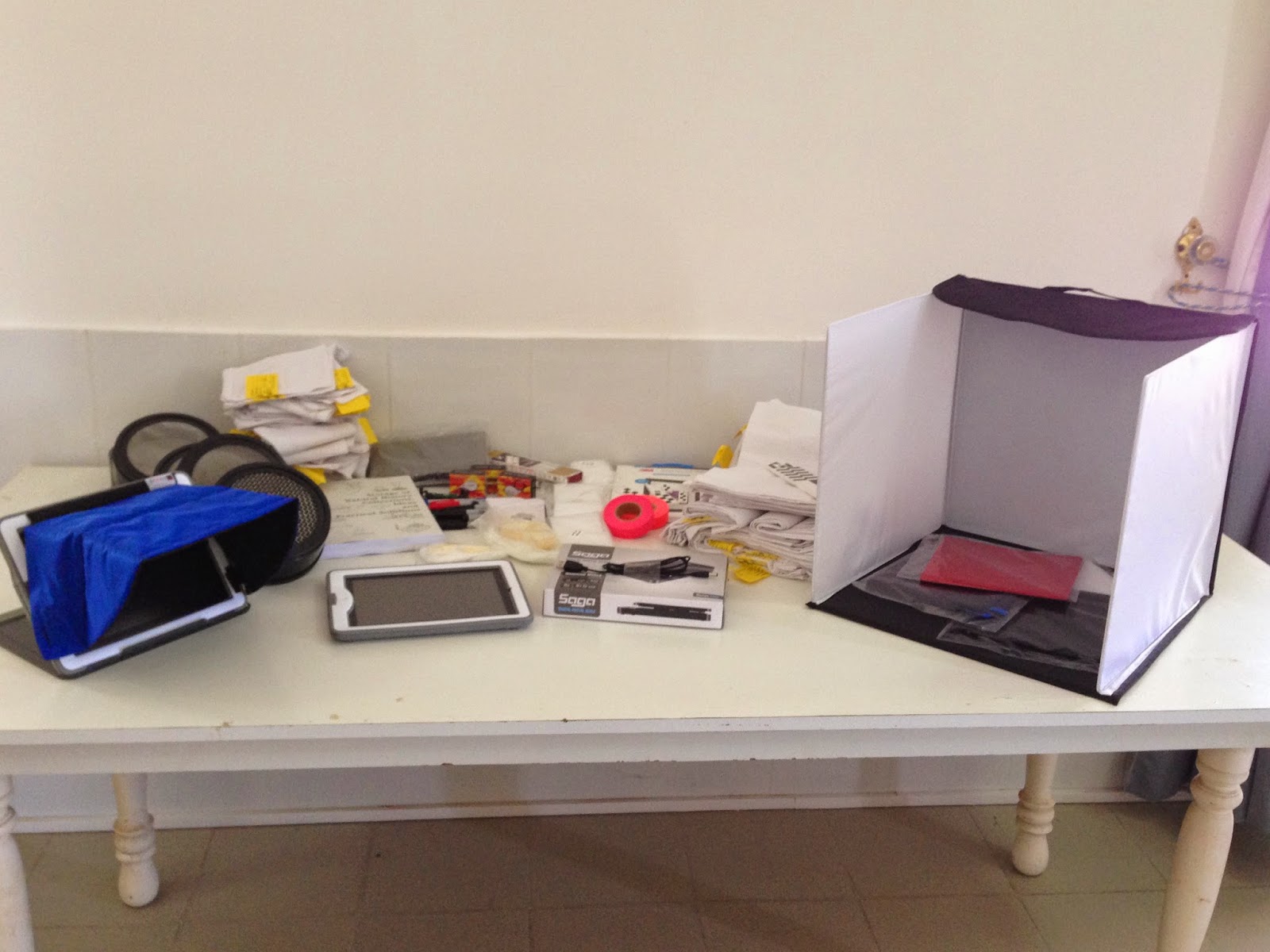
One of the most important things we purchased are cloth bags for gathering artifacts.  Last year we had to use plastic, not only are they not recyclable but they also sweat or trap in the moisture when it starts raining.  We have 100 large & 100 small cloth bags that we can use again and again since we have pretty “clean” dirt here at Al Baleed.


The other major purchase was an iPad for the students to use.  That put us up to seven iPads!  Four of those are for inside use only--Brian, Sarah & I all have our personal ones for use inside the lab.  Brian works on the database, Sarah uses hers for Ceramic Analysis and I use mine for all the Lab data entry.  The fourth one is an old iPad that we use as the “library” it has a few books, documents, dictionaries, etc for the students to read in their spare time.  The other three iPads are in the field every day.  Krista has her personal one, the new one from Indigogo & Sarah’s University (ASU) helped her purchase one for student use as well.  We are forgoing almost all paper & using iPads for all forms, notes, etc.

The iPads all work together & the info is all shared & saved due to a database. This database is a major undertaking--the entire thing has been created by Krista, Brian & Kevin Geiss (who is back in the States--big shout out to Kevin!)  They started with FileMaker Pro software & designed everything for our archaeological use.  Major brain power needed to make all this work!

Along with the bags & iPad we also purchased things like tape measures, line levels, folding rulers, Lifeproof cases for the iPads (to keep out sand & water), photo scales, special plastic bags (that don’t harm the artifacts for packing & storage), labels for tagging artifacts, flagging tape, string, and a few other odds & ends that keep a dig running.  

One last super cool thing Brian found is called Hoodi--it's the blue thing in the picture above.  It attaches to the iPads to block the glare when taking photos or just using the iPads in the field.  There is also a gray one in the back of the other photo.  The combo of the Hoodi, the anti-glare screen protectors and the Lifeproof cases all make it much easier to use the iPads here on the very, very, sunny Tropic of Cancer.

We've been digging for one week now.  The students are getting the hang of things in the field and the lay of the land here in Salalah.  We've already found a few cool artifacts, some interesting walls, and we've managed to start training 15 workers... but that's for another post.